
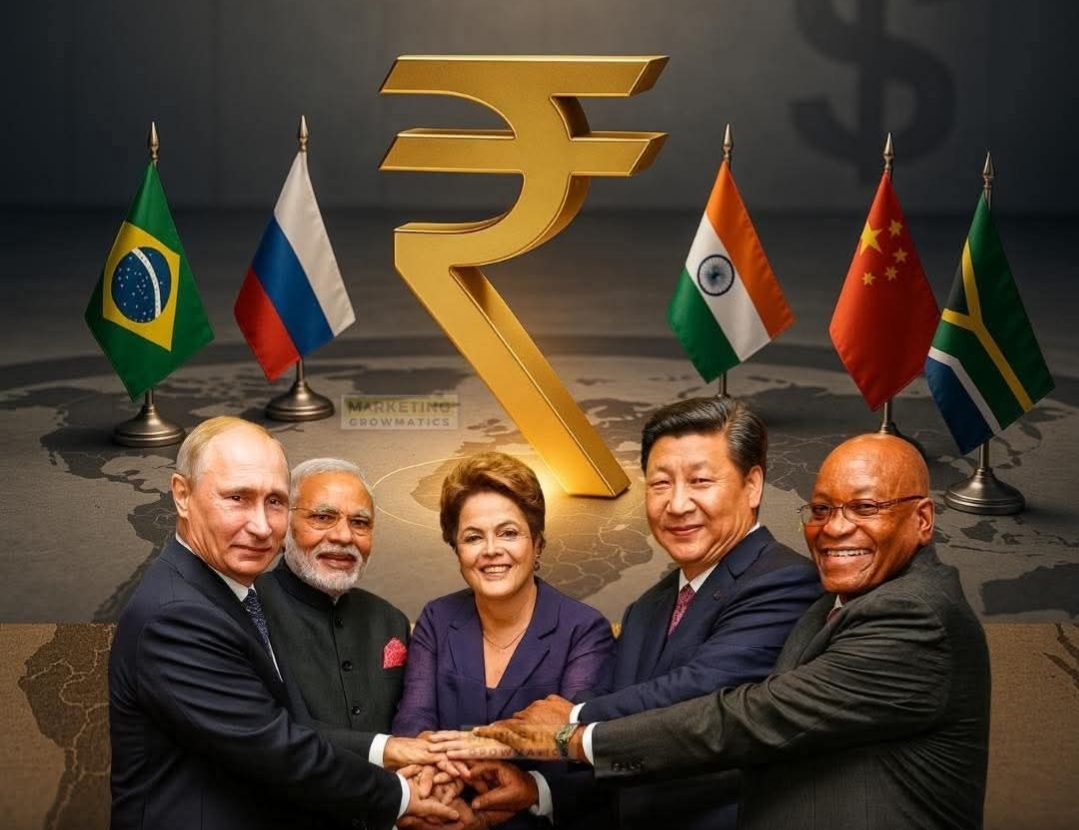
For decades, the US dollar has been the undisputed king of global trade. But now, for the first time ever, BRICS nations—Brazil, Russia, India, China, and South Africa—are officially settling trade in Indian rupees, marking a historic shift in the world’s financial landscape . This isn’t a full-scale abandonment of the dollar, but it is a bold and strategic step toward making the rupee a global currency .
India’s strategic move to internationalize the rupee comes amid broader efforts by BRICS members to reduce dependency on the US dollar and explore alternatives for cross-border transactions. While the idea of a common BRICS currency has largely stalled, India’s bilateral approach is gaining real-world traction .
🌍 Why This Move Matters: Beyond Symbolism
India’s push for rupee-based trade settlements is a multi-faceted strategy with profound implications. Here’s why it matters:
- Reducing Reliance on the US Dollar
The dominance of the US dollar has long meant that emerging economies are vulnerable to its fluctuations, US monetary policy shifts, and potential sanctions. By enabling trade settlements in rupees, India and its BRICS partners are creating a buffer against these external pressures. For instance, the Reserve Bank of India (RBI) has already operationalized mechanisms allowing countries like Russia and the UAE to conduct trade in rupees without first converting funds into dollars . This reduces transaction costs and minimizes foreign exchange risks for businesses. - Strengthening India’s Role in World Trade
India is positioning itself as a key player in the future of global trade. By inviting BRICS nations to settle transactions in rupees, India is not only enhancing its economic sovereignty but also expanding its influence within the bloc and the broader Global South . The RBI’s recent circular allowing banks to freely open Special Rupee Vostro Accounts (SRVAs) for foreign banks has streamlined this process, making it easier for partner countries to hold and transact in rupees . - Paving the Way for a Global Rupee
Although the rupee is not yet fully convertible, this initiative is a critical step toward its internationalization. The RBI is actively engaging with countries in Asia and Africa to establish similar arrangements, and successful pilot projects with Russia and South Africa have demonstrated the feasibility of rupee-based settlements for key commodities like oil and pharmaceuticals . If these efforts gain momentum, the rupee could gradually evolve into a widely accepted currency for international trade, much like the Chinese yuan.
⚙️ How the Rupee Trade Mechanism Works
The operational backbone of this system lies in the Special Rupee Vostro Accounts (SRVAs). Here’s a simplified breakdown:
- A foreign bank (e.g., from Russia or Brazil) opens an SRVA with an authorized Indian bank.
- The foreign country deposits rupees into this account through exports to India or other means.
- These rupees are then used to pay for imports from India without any dollar intermediation .
For example, if Brazil wants to purchase Indian pharmaceuticals, it can pay directly from its rupee reserves held in an SRVA. Similarly, India can buy Russian oil using rupees instead of dollars . This mechanism not only eliminates conversion fees but also shields transactions from geopolitical tensions and sanctions.
📈 The Bigger Picture: BRICS and De-Dollarization
India’s rupee initiative is part of a broader BRICS agenda to promote de-dollarization. However, it’s important to note that India has never explicitly endorsed full de-dollarization. Instead, it has taken a pragmatic approach, focusing on bilateral agreements that offer immediate benefits rather than waiting for a complex multilateral solution like a common BRICS currency .
This strategy aligns with the realities of the global financial system. The US dollar still accounts for nearly 90% of foreign exchange transactions and about 58% of global foreign reserves . Replacing it is impossible in the short term. However, by promoting local currency settlements, BRICS nations are collectively chipping away at dollar dominance. Notably, around 90% of intra-BRICS trade is already settled in non-dollar currencies .
🚧 Challenges and the Road Ahead
Despite the enthusiasm, significant hurdles remain:
- Exchange Rate Volatility: The rupee has depreciated against the dollar over the past five years, raising concerns about its stability as a trade currency .
- Convertibility Issues: The rupee is not fully convertible, limiting its utility outside bilateral agreements.
- Infrastructure Gaps: Efficient settlement systems like Payment-versus-Payment (PvP) arrangements are underdeveloped for currency pairs involving the rupee .
- Geopolitical Balancing: India must carefully navigate its relationships with both BRICS partners and Western nations, as it still relies heavily on Western technology and investment for its development goals .
Nevertheless, India’s proactive efforts—such as allowing non-residents to invest surplus rupee balances in government securities and establishing currency swap lines with SAARC countries—are steps in the right direction .
💡 What This Means for the World
India’s rupee settlement system is more than a financial policy; it’s a geopolitical statement. By challenging dollar hegemony, India is asserting its economic autonomy and offering an alternative model for emerging economies. If successful, this could inspire other regional blocs like ASEAN and the African Union to explore similar frameworks .
For businesses, this shift promises reduced transaction costs, faster settlements, and less exposure to dollar-driven volatility . For investors, it opens new opportunities in BRICS financial markets and commodities. And for India, it’s a leap toward becoming a true global economic power.
✅ Conclusion: The Rupee’s Ascent Has Begun
The move to settle BRICS trade in rupees is a watershed moment. It reflects India’s rising confidence and the bloc’s collective desire for a more multipolar financial world. While the dollar’s dominance is far from over, the rupee’s journey from local markets to global trade tables is well underway. As RBI Governor Sanjay Malhotra aptly noted, “It takes years, it takes decades for local currencies to gain, to become popular” . But with each bilateral agreement and each trade settled in rupees, that future becomes more tangible.
India, be proud. The rupee is rising. 🌟🇮🇳
References: